What is biodiversity?
Biodiversity refers to the entire spectrum of life on Earth. It encompasses all different species of plants, animals, fungi, and microorganisms, as well as the diversity within these species and the ecosystems they form.
Biodiversity can be examined at three different levels:
- Genetic diversity, which means the variation within a single species. This allows the species to adapt to changing conditions and persist.
- Species diversity, which refers to the abundance of species in a particular area or ecosystem.
- Ecosystem diversity, which refers to different habitats.
The entire existence of humankind depends on diverse living nature; therefore, it is concerning that the Earth’s carrying capacity has already been exceeded in terms of biodiversity.
The decline in biodiversity is a serious phenomenon caused by changes in land and marine use, overexploitation of natural resources, excessive use of animals and plants, destruction of habitats, climate change, pollution, and invasive species.
Over 75% of the Earth’s surface and 66% of marine areas have been significantly altered by human activities.
There are system-level underlying factors, such as consumption patterns, population growth, governance challenges, and economic models where environmental costs may not be fully accounted for.
Human well-being and the economic activity of society and enterprises are dependent on the ability of nature to provide ecosystem services. Simultaneously, human and business activities impact nature and biodiversity.
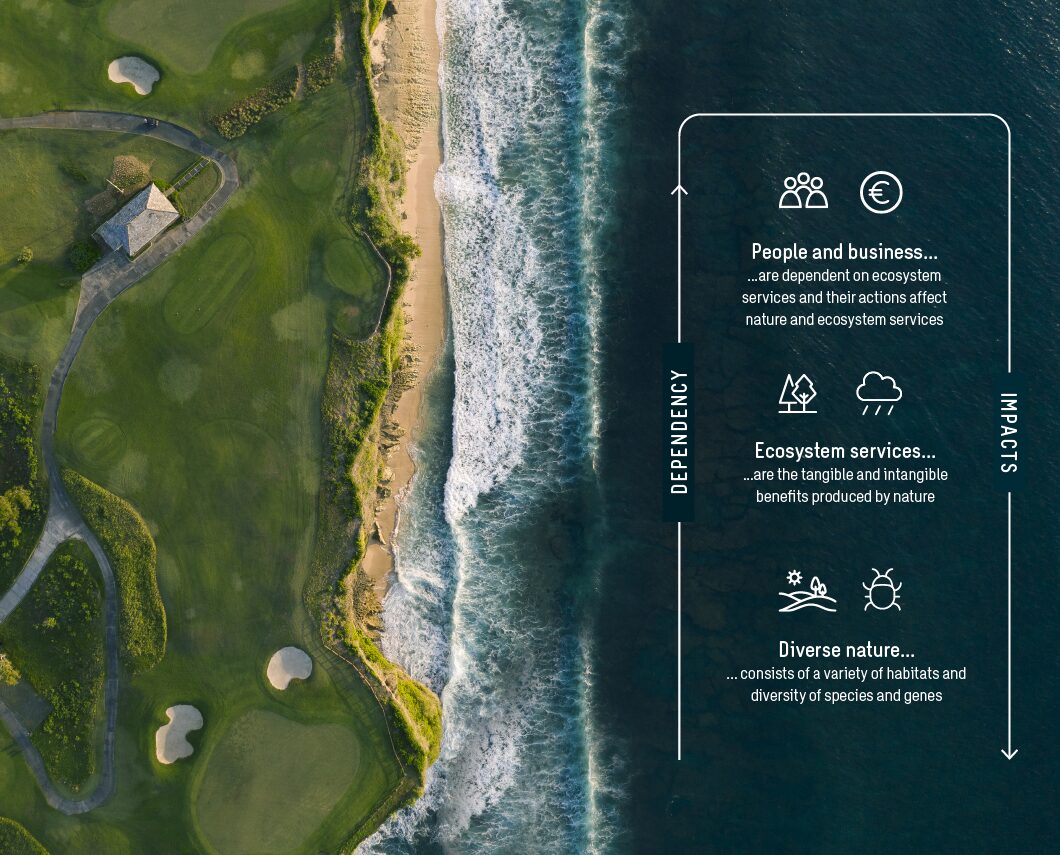
People and businesses are dependent on nature’s capability to provide ecosystem services. At the same time, people and businesses impact nature causing degradation of its functions.
The functioning of ecosystem services is dependent on biodiversity
Biodiversity is essential for maintaining ecological balance. When diverse living nature functions normally, it produces material and intangible benefits called ecosystem services. These are typically categorized into four groups:
- Supporting services: e.g., oxygen production, photosynthesis, soil formation, carbon sequestration, water, nitrogen, carbon, and nutrient cycling.
- Regulating services: e.g., groundwater formation, plant pollination, erosion and climate regulation, flood and extreme weather mitigation and prevention.
- Provisioning services: e.g., plants, fungi, animals, fresh water, fibers, building materials, minerals, energy and fuels, medicines.
- Cultural services: e.g., identity, culture, art, spirituality, education, aesthetics, recreational use.
All of these are critical for human survival and well-being and directly affect also business activities.
Biodiversity degradation causes global human and economic losses
The degradation and unsustainable use of ecosystems increase the likelihood of nonlinear and potentially irreversible changes.
Clean air and water quality and availability, food production, and pollination, as well as resilience of ecosystems, are all under threat or disruption. According to IPBES (Intergovernmental Science-Policy Platform on Biodiversity and Ecosystem Services), risks include particularly weakened food security, reduced fresh water availability, and increased pests or diseases.
Biodiversity loss leads to economic losses, particularly in industries directly dependent on nature and natural resources.
Generally, all companies and business sectors can face biodiversity-related risks through their value chains or as a result of system-level instability.
In addtion, climate change and biodiversity loss are strongly interconnected.
Climate change causes the Earth’s temperature to rise, sudden weather changes and extreme weather events, which disrupt ecosystems and habitats. The biodiversity loss, in turn, weakens ecosystems’ ability to sequester carbon and regulate the climate, thus accelerating climate change.
Importance of biodiversity to the global economy
Preserving biodiversity is crucial for the continuity and profitability of global business.
Over half of the world’s GDP is highly or moderately dependent on natural ecosystem services.
The collapse of ecosystem services could, according to a moderate estimate, reduce global GDP by nearly €2.6 trillion by 2030.
Companies can face biodiversity-related risks through their value chains or system-level instability, highlighting the need to consider biodiversity in economic decision-making.
International biodiversity goals
The goal of the global biodiversity framework agreed upon at the UN (The Kunming-Montreal Global Biodiversity Framework) is to stop and reverse the loss of biodiversity by 2030 with ambitious targets:
One significant target is that 30 percent of land and marine areas must be protected, and 30 percent of degraded areas and ecosystems must be restored.
For example, in Europe, only 20% of land and 13% of marine areas are protected by 2025, which is far from the target of 30% protection by 2030. This shows that more actions and commitments are required to protect biodiversity.
However, the EU has been ahead of the curve, having drafted its own European biodiversity strategy for 2030 before the global framework, which is part of the EU’s Green Deal and sets goals for protecting biodiversity within the European Union.
The European biodiversity strategy aims to, among other things, restore 20% of the EU’s land and sea by 2030 and reduce the use of chemical pesticides by 50%. The strategy also seeks to increase organic farming to 25% of agricultural land and halve the nutrient loss in agriculture.
Commitments and goals have been created both internationally and at the state level, but next, roadmaps and guiding actions are needed to achieve these goals.
Take action to promote biodiversity!
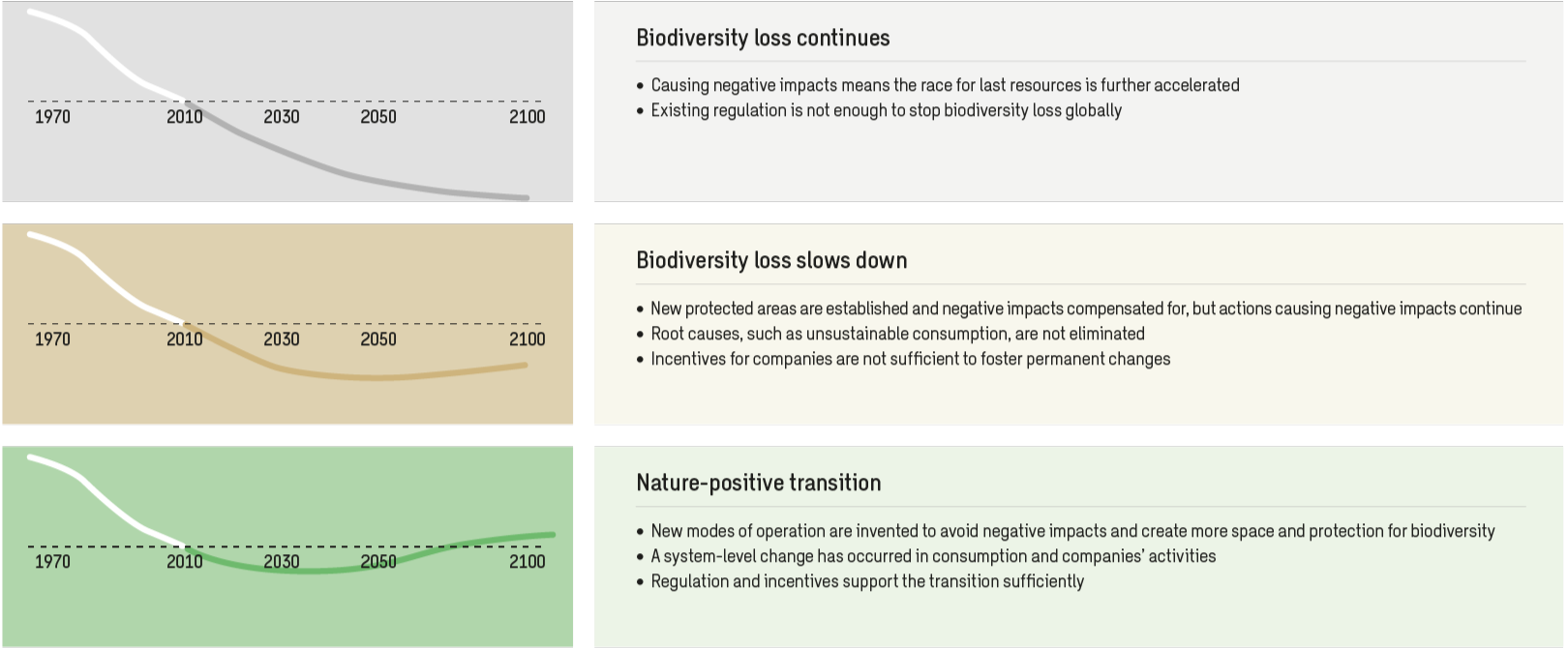
Illustrative scenarios of the effects of different biodiversity measures on biodiversity loss.
Securing biodiversity is essential both for ecological balance and the well-being of people and society. Preserving natural diversity is not only an environmental issue but also an economic and social challenge.
Safeguarding ecosystem services and curbing biodiversity loss require active and sustainable measures at all levels, including economic decisions and investments.
Paying more attention to biodiversity in current business operations and searching for new business opportunities that support biodiversity is important. This can mean developing solutions that reduce pressure on nature or are regenerative, giving more to nature than taking.
Ecological compensation markets and protecting natural diversity are key measures by which companies can mitigate their impacts on natural diversity after avoiding and reducing measures have been exhausted. Green financing options and biodiversity risks included in investment analysis are examples of economic mechanisms that support biodiversity.
In summary, natural diversity is a vital part of Earth’s ecosystems and human life. Protecting it requires collective efforts, innovative solutions, and commitment at both national and international levels.
Understanding and valuing biodiversity is crucial in developing solutions that benefit both the planet and humankind in the long run.
Piia Pessala, Business Lead, Biodiversity strategies and management
We are happy to help you with biodiversity issues!
Piia Pessala
Strategic planning