Published 13.1.2026
Elevated Tornio River railway bridge connects neighboring countries for the future
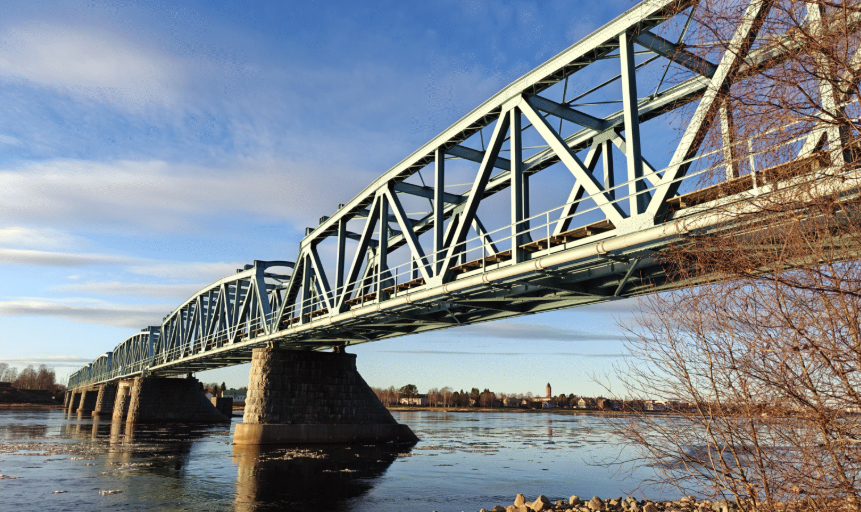
The only rail link between Finland and Sweden crosses the Tornio River. The bridge was raised to allow electrification of the line and future passenger traffic. Sweco was responsible for designing the repairs of this historically valuable railway bridge.
Widening the Tornio River railway bridge for electrification
The railway bridge over the Tornio River is a vital connection for Finland’s and Sweden’s security of supply. The renovation aimed to enable electrification and increase regular train traffic.
“The Tornio River railway bridge is the only rail bridge on the Finland–Sweden border and the only rail link to the west,” emphasizes Jukka Päkkilä, Project Manager at the Finnish Transport Infrastructure Agency. Unlike all road bridges, which are managed by one state, the Tornio River railway bridge is shared. Therefore, the repairs were carried out according to the guidelines of both countries. “Sweco supported our dialogue with Sweden’s Trafikverket, as some of the designers have experience in bridge design for Sweden as well.”
Tornio River railway bridge in brief
Client: Finnish Transport Infrastructure Agency (Väylävirasto) and Swedish Transport Administration (Trafikverket)
Services included: Bridge design, including widening for clearance, steel structure and geotechnical design, as well as calculation and site services
Implementation period: 2022–2025
Key themes: Bridge of the Year 2025, cross-border cooperation, the only rail link to the west, supporting Finland’s and Sweden’s security of supply
New structures and connections added to the upper part of the steel truss bridge
The steel truss structure of the Tornio River railway bridge was raised to accommodate overhead electrification wires. “In recent years, the bridge has only carried freight traffic, but the new safety and electrical systems will enable passenger services between the two countries,” says Terhi Honkarinta, Project Manager at the Finnish Transport Infrastructure Agency.
Completed in 1919, the over 400-meter-long bridge consists of six steel trusses: two on the Finnish side, three entirely in Sweden, and a shared central section that could be opened for ships until the 1980s. Sweco’s bridge designers advanced the rail plan and determined which crossbeams and wind bracings needed replacement.
“Ultimately, about half were replaced on the Finnish side, more than half at the old lift span, and all crossbeams and wind bracings in Sweden’s level trusses,” explains Sami Noponen, Sweco’s Bridge Design Project Manager. “This required extensive calculations for connections between new and old structures, as well as load-bearing capacity checks for existing components.”
Respecting a century of history in bridge design
According to Honkarinta, the design aimed to extend the life of the 100-year-old bridge while honoring its heritage. The Tornio River railway bridge is one of Finland’s oldest. “The widening had to be planned so that the beautiful old bridge was altered as little as possible.”
The shape of the elevation was carefully considered, and the visual appearance of the new sections was approved by Swedish authorities. “Curvature was added to the angular trusses, and the new structures were fully repainted on the Finnish side and spot-painted on the Swedish side,” Noponen says.
Päkkilä is pleased with the result: “The renewed bridge is visually striking, and both the electrification structures and beam shapes respect the bridge’s age.”
Precision of steel structure plans verified On-site
Honkarinta emphasizes that smooth cooperation was key—both in cross-border dialogue and during implementation between the client, designers, and contractor. “Bridge designers were needed more than usual during construction because not all initial data was available.”
Steel design had to account for deviations from the original hand-drawn plans. “The old drawings were skillfully made but not dimensionally accurate,” Noponen notes. Measurements were refined on-site by Kreate through additional surveys.
When widening the wind bracings, new crossbeams had to be installed before removing the old upper sections. “We developed birdhouse-like spacer structures that served as attachment points for side supports and wind bracings, which were installed last,” Noponen explains.
Load-bearing calculations secured new structures
A critical part of the repair design was demanding load-bearing calculations. Sweco’s bridge engineers analyzed how the widening affected the bridge’s capacity, connection by connection.
“The calculations were extensive due to the complex structure with many details,” Noponen says. The transverse stiffness of the upper parts had to remain at least unchanged, and additional checks were made for the lower parts and ice loads on intermediate supports.
New connections were built as bolted joints since rivets are no longer used in Finnish bridges, and all remaining riveted joints were inspected with ultrasound.
The Finnish Association of Civil Engineers (RIL) selected the Tornio River railway bridge as Bridge of the Year 2025, recognizing it as an exemplary project showcasing high-quality Finnish bridge repair expertise.