
Kalasatama–Pasila alliance renewed infrastructure construction
Published 27.2.2026
The Kalasatama–Pasila tram line was designed in the heart of a rapidly developing Helsinki. Sweco’s infrastructure designers played an extensive role in the Sörkän Spora alliance, which reflected takt-based construction, the City of Helsinki’s sustainability goals and coordination with multiple parallel projects. Näkymä Oy, now part of Sweco, was responsible for environmental design in the Nylanderinpuisto and Vallilanlaakso areas as part of the Karaatti alliance. The Kalasatama–Pasila project won the Environmental Structure of the Year 2025 award.
Kalasatama–Pasila delivered as parallel alliances
The Kalasatama–Pasila alliance designed and built the line for Tram 13, connecting Nihdi, Kalasatama, the Kumpula Campus and Pasila. The approximately 4.5‑kilometre tramway was completed on schedule and under budget in 2024, and the journey now takes only 12 minutes.
Kalasatama–Pasila was Finland’s first infrastructure project delivered as two parallel alliances. Sweco’s designers participated in the Sörkän Spora alliance together with WSP and Destia. Their responsibility covered the section from Nihdi through Kalasatama along Hermannin Rantatie to Haukilahdenkatu. In addition, Näkymä Oy, part of Sweco, was responsible for environmental design in Nylanderinpuisto and Vallilanlaakso as part of the Karaatti alliance.
“Approximately 100 Sweco experts worked on the alliance, designing the technical systems for the track, municipal engineering, streets, traffic, and earth and foundation structures,” says Tero Savolainen, Sweco’s Project Manager.
According to him, the parallel alliance setup brought new elements to the familiar alliance model. Sweco has previously been involved in projects such as Raide-Jokeri, Kruunusillat and various phases of the Tampere Tramway. The team spirit was excellent: “Everyone was on the same page on site, with no divide between designers and builders. We worked as one team!”
Kalasatama–Pasila project (Sörkän Spora alliance) in brief
Client: City of Helsinki’s Urban Environment Division and Helsinki City Transport HKL (later Metropolitan Transport Ltd, KLOY)
Services included: geotechnical design, municipal engineering and utilities, street and streetscape design, landscape design, bridges and special structures, tram track structures and technical systems, temporary traffic arrangements, safety and risk management
Implementation period: 2019–2024
Sustainability actions: CEEQUAL certification, application of BREEAM Infrastructure framework, over 80% recycling rate, reuse of excavated soil, use of low‑carbon concrete, diverse trackside vegetation.
Designing a tram line in the middle of an active city
Kalasatama is one of Helsinki’s busiest transport hubs and a major infill development area. According to Sweco’s Traffic Design Project Manager Lotta Aittokallio, parts of the street areas in the Kalasatama Centre had to be pre-built for the tram, but changes were still needed.
“In a dense urban environment you can’t just add tracks on top of an existing street. Many parts of the surrounding area required complete reconstruction, including utility relocations.”
The tram line itself was only a small portion of the alliance. For example, the 50‑metre-wide Hermannin Rantatie was completely redesigned. “The entire street environment became more pleasant thanks to new green areas, pedestrian routes and cycling lanes,” Savolainen notes.
At Hermannin Rantatie, preparations were made for the future Sörnäinen tunnel by excavating the tunnel mouth 20 metres into the bedrock. “The entrance is covered and waiting, so future tunnel construction will not disrupt tram traffic for long,” Savolainen explains.
Significant coordination was required with Pasila’s existing tram network and surrounding construction projects, from Redi’s tower buildings to Hermannin Rantatie’s housing developments and the Kruunusillat project in Nihdi. “At one point, three separate building projects were underway inside the turning loop in Sompasaari,” Aittokallio recalls.
Environmental design and a cohesive urban park landscape
The Kalasatama–Pasila project also renewed the Nylanderinpuisto and Vallilanlaakso areas. Näkymä Oy, now part of Sweco, led the environmental design in the Karaatti alliance, aiming to create a green, diverse and sustainable urban park environment.
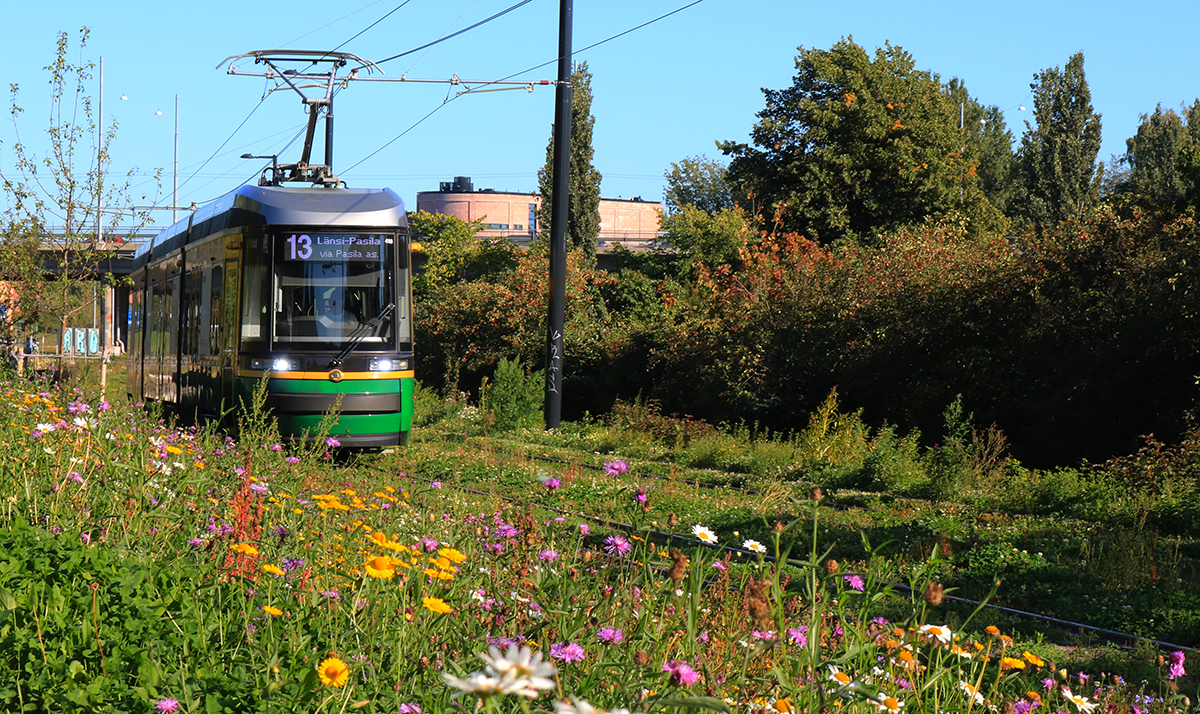
The park areas were completely reshaped, the tram line and a new cycling lane were integrated into the landscape, and the Kumpula Stream channel was restored to a more natural state. In Vallilanlaakso, stormwater management was improved with new open channels, and new recreational and walking routes were added. Recycled materials, diverse vegetation and KESY principles strengthened the ecological value of the area and enhanced urban biodiversity.
Efficient temporary traffic arrangements on the tramway construction site
The wide project area required extensive temporary traffic arrangements. Sweco’s solutions prioritised safety and the needs of pedestrians and cyclists. The area included bus routes and a special transport corridor.
“Phase-based takt production influenced the design of temporary traffic arrangements—something still quite new in infrastructure construction,” Savolainen says.
Aittokallio adds that everyday convenience, community well-being and the cityscape were important. “We received particularly positive feedback on the temporary cycling lane and the roundabout at the Työpajankatu–Hermannin Rantatie intersection. Residents even wished for it to become permanent!”
Sustainability guided the Kalasatama–Pasila alliance
The City of Helsinki’s sustainability goals influenced many aspects of the project, from circular economy principles to green infrastructure. 89% of excavated soil was reused on site, improving the project’s overall sustainability. The added vegetation significantly reduces urban heat and manages stormwater, as verified by independent assessment.
“Climate change adaptation was also considered in the geotechnical design of Hermannin Rantatie,” Savolainen explains. The street level was raised by around 2.5 metres due to flood risks near the sea. Because of weak soil-bearing capacity, a massive piled slab was required under the tramway. “Low‑carbon concrete was used in the slab construction, reducing carbon emissions.”
The impact of sustainability measures was verified through CEEQUAL certification and the BREEAM Infrastructure framework.
Header image: Kalasatama–Pasila project, Aarni Salomaa
Bottom image: Kaupunkiliikenne Oy