In the landscape design of Kaisaniemi Park, diverse stakeholders are heard, history is preserved, and trees are conserved
Published on 4 May 2026
The goal of the basic renovation of Kaisaniemi Park is to renew the park’s overall appearance and atmosphere while celebrating the different historical layers of this historic park. Sweco’s landscape architects brought together the history of a valuable urban park, new functionalities, and extensive construction projects in the surrounding area—while preserving the existing mature trees.
Kaisaniemi Park returns as a pleasant and safe urban park
Kaisaniemi Park is the oldest historic park in the centre of Helsinki and the oldest public park in all of Finland. The multi-year basic renovation project began in 2019 with park planning. The aim was to restore the pleasant atmosphere and attractiveness of this valuable urban park.
“The park has been in need of renovation for a long time, and unfortunately it has had a poor reputation due to disruptive behaviour and a lack of safety,” says Jere Saarikko, Project Director for the City of Helsinki. “We are all eagerly awaiting the completion of the renewed park!”
The landscape architect has nearly 30 years of experience
Kaisaniemi Park is protected by the local detailed plan and classified as a nationally significant built cultural environment. According to Jere Saarikko, the landscape architecture firm Näkymä—now part of Sweco—had exactly the kind of experience needed for the basic renovation of Kaisaniemi Park.
“Our framework agreement partner has extensive experience in both historical sites and other particularly demanding park and landscape design projects.”
Sweco’s landscape architect Tiina Perälä has worked on the restoration of cultural heritage sites for nearly three decades. “I became enthusiastic about the field already during my studies at the Helsinki University of Technology, under the guidance of the highly respected teacher Eeva Ruoff,” she says.
Kaisaniemi Park contains many historical layers
In the basic renovation, the park’s historical layers were highlighted while functionality, circulation routes, and furnishings were upgraded to 2020s standards. The park’s tennis courts will be moved close to Kaisaniemenkatu on the eastern side of the park, where outdoor fitness equipment will also be installed. The old sports field will be transformed into a versatile event area for public gatherings.
“Between events, the backstage area will serve as a space for Helsinki residents to spend time, offering a variety of new functions such as skateable park furniture,” says Sweco landscape architect Tiina Perälä, who has served as the project’s lead designer and project manager.
Amid the renovations, the park will retain many existing elements, including its curved pathways and overall composition. “The park’s character will continue to be defined by the east–west and north–south axes,” Perälä says. Existing lawn areas will be preserved, and stone materials will be recycled. “Edging stones and cobblestones will be reused, for example, in stormwater channels.”
One of the park’s defining features is the Kaisaniemi pond, completed in the 1920s, which will be fully restored. “The pond will certainly become one of the park’s main attractions,” Saarikko predicts. Rows of white willow trees that previously lined the pond will also be reinstated along its edges.
Old trees are renewed according to the principle of continuous growth
Protecting trees and other vegetation has been a shared goal of residents, landscape designers, and the City of Helsinki. Therefore, the old birch avenue will be maintained according to the principle of continuous growth. Only the most deteriorated trees will be felled and left as deadwood.
“The avenue will not be renewed all at once, but gradually supplemented with new birch trees as gaps appear,” Saarikko explains. “More important than the visual appearance of the avenue is maintaining the continuity of the old trees, which supports biodiversity and also takes social values into account.”
The existing tree population has also been a key consideration in the renovation of the park’s playgrounds. According to Perälä, choosing solutions that fit the milieu has required balancing history, functionality, safety, and the protection of old trees. Ultimately, compromises were made regarding the use of surface materials suited to a cultural-historical setting, such as safety sand.
“Leveling the main playground would have required substantial earthworks, so we gave that up and instead preserved a few more old trees.”
Construction projects in the surrounding area shaped the park plan
One of the most challenging aspects of the renovation has been the numerous major construction projects in and around the park, such as the renovation of the National Theatre, the Kaisaniemi Tunnel, the RED Hotel, and the Kluuvi flood pumping station. The park plan has had to be modified to an exceptional extent.
“However, Tiina has demonstrated the patience and, above all, the flexibility required of a lead designer,” Saarikko praises.
The amount of renewed infrastructure within the park has been unprecedented. “For example, a stormwater sewer with a diameter of 1.6 metres was constructed through the historic park, which meant excavations four metres wide,” Perälä explains. “Our role as landscape designers has been to reconcile different wishes and to defend the park’s historical framework.”
Helsinki residents are once again enjoying Kaisaniemi Park
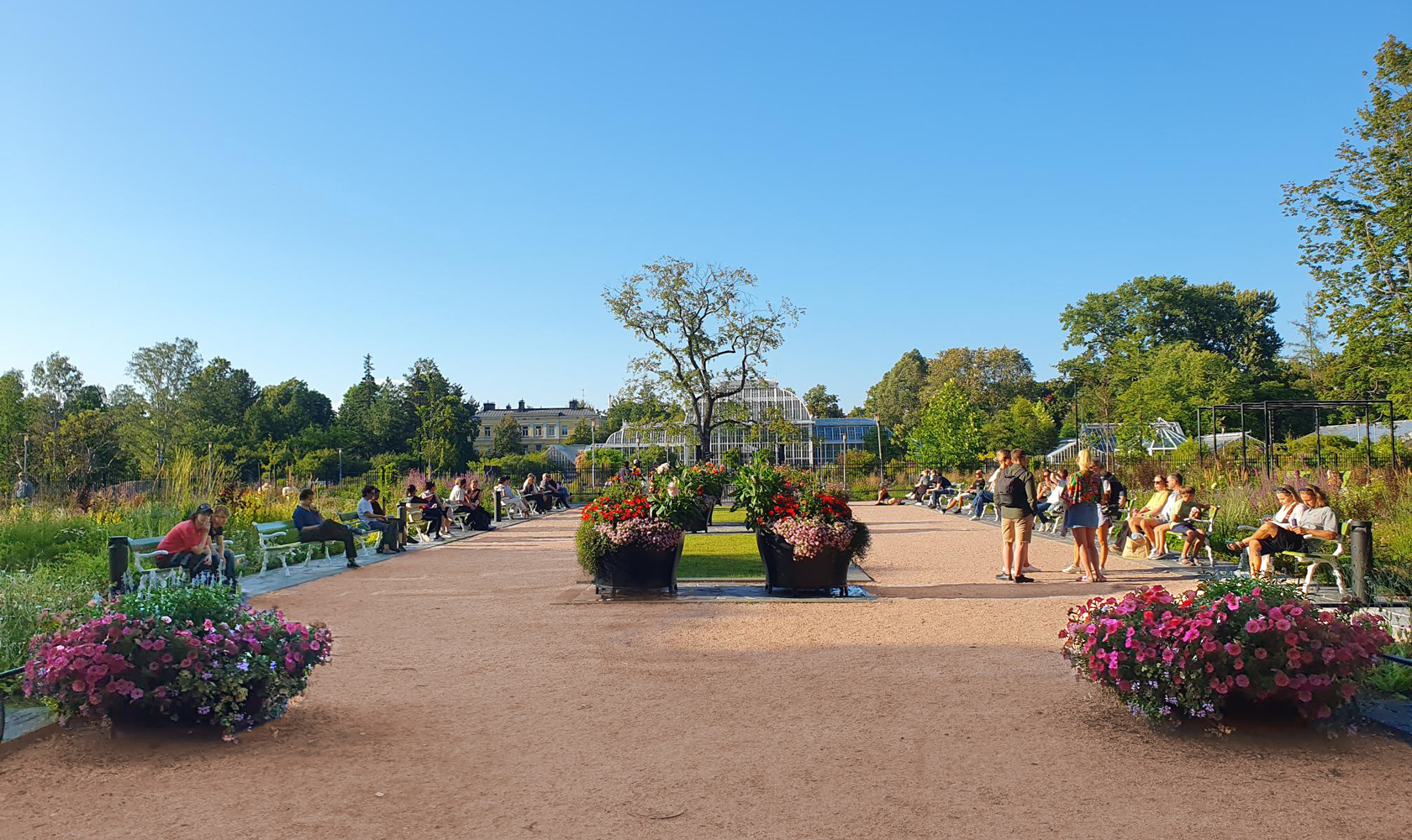
The basic renovation of Kaisaniemi Park will continue until the end of 2027, but the changes already completed have received positive feedback from users. Saarikko himself, along with many other Helsinki residents, has been particularly delighted with the new entrance to the Botanical Garden.
“It makes the green area as a whole more coherent and opens the park toward the south as well.”
The entrance garden, which blends seamlessly with the rest of the park landscape, includes a large number of new shrub and perennial plantings. According to Perälä, the design and planting work was quite an undertaking. “About 68,000 plants and more than 200 different plant species or cultivars were planted in the garden!”
Residents have also welcomed the replacement of vehicular traffic with a bicycle boulevard, and all of the park’s main routes are accessible. Accessibility, safety, and comfort have further been improved with new lighting and by opening up sightlines. “In the end, however, the atmosphere of the park is shaped above all by people—the park’s diverse users,” Perälä emphasizes.
Kaisaniemi Park basic renovation in brief
Client: City of Helsinki
Scope of services: Landscape design and lead design
Implementation period: 2019–2027
Sustainability in the project: vehicular traffic was replaced with a bicycle boulevard; main routes are fully accessible; the old birch avenue is renewed according to the principle of continuous growth; trees over 100 years old and other existing vegetation were preserved; 68,000 plants and more than 200 different plant species or cultivars were planted in the entrance garden to the Botanical Garden; old edging stones and cobblestones are reused
During the basic renovation, the park plan had to be modified due to numerous infrastructure and building construction projects carried out in the park and its immediate surroundings.