
The architecture of the new building was designed as part of the milieu of Kuninkaankatu
Published 2.9.2025
Sweco’s architects supported the property owner’s vision in the zoning change and additional construction of the property complex located on Kuninkaankatu in Tampere. The new building was designed as part of the surrounding building stock and simultaneously as part of the history of Tampere city centre.
The plan change enabled additional construction on Kuninkaankatu
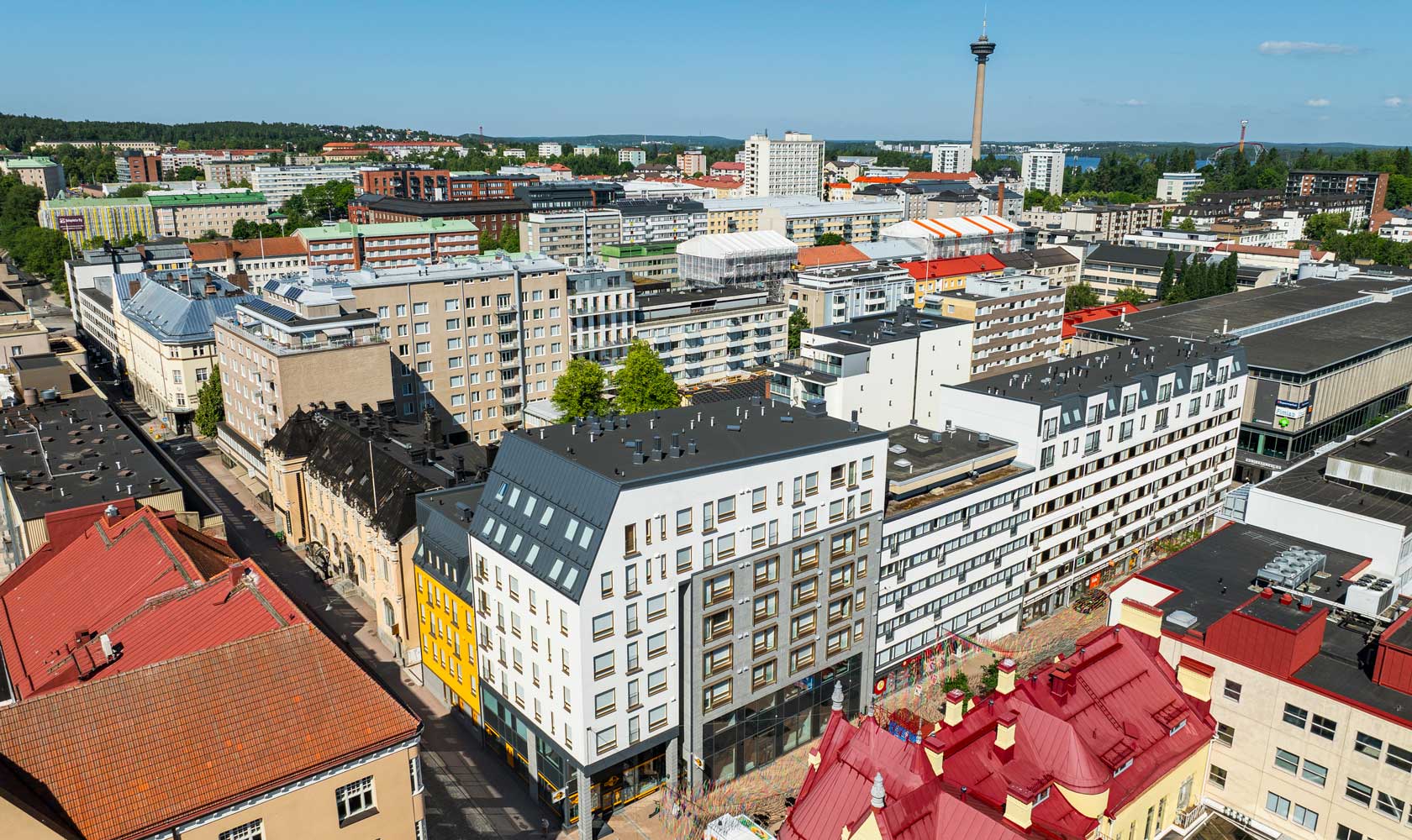
A new building was completed in 2023 on Kuninkaankatu in the Tammerkoski district of Tampere, creating a coherent property complex with several buildings. The background is a longer-term project in which additional building rights were applied for a property from the 60s.
“The change was carried out in several stages. First, the apartments were renovated from offices, then the attic was raised, and finally the old property was renovated,” says Tuija Schmidt, the property owner’s representative. The last to be completed was a 10-storey new building on the corner of the street, replacing the old restaurant wing.
The project started with land use planning and preliminary preparation of land use planning. It included a building history report because the plan was changed in a valuable environment in the heart of Tampere.
“There is a demand for infill construction along the former main street of Tampere, and the plot was previously inefficiently used,” says Sweco’s architect and chief designer Teemu Mikkola.
Project summary
Project: Housing Company Kuninkaankatu 24 (Tampere)
Client: Private property owner
Services included in the assignment: Lead design and zoning/urban planning architectural design
Year(s) of implementation: 2011–2023
The apartment building was designed on top of old foundations
For the property owner, the help of the architects was important both in envisioning the future use of the building and in cooperation with the city’s building permit authorities. “We also had to take into account the financial perspective and the rentability of the apartments,” Schmidt adds.
Commercial premises were planned for the new building at street level, offices on the second floor and apartments above them. According to Mikkola, a symbiosis was created from diverse materials, and the building is architecturally naturally integrated into the surrounding building stock. “It required the coordination of different structural solutions, technology and façade styles.”
Two basement floors were preserved under the building, the first of which has a shared parking garage for the entire block. As few new foundations as possible were made, so the new building was designed on top of the existing structures, which influenced the façade architecture.
“Eventually, the load-bearing exterior walls of the basement were also used as load-bearing structures above ground, which limited the number of window openings, for example,” Mikkola says.
The façade architecture of the new building has several aspects
However, the massing of the building remained, which made it possible to build parts of different heights in accordance with the architect’s vision. On the side of the Tampere Student House, the wing of the new building is lower and the yellow façade has a similar spirit.
“On the Kauppakatu side, the tall white façade of the new building takes a stand on the protected Art Nouveau building, the National Bank Building. The sloping roof slopes from there towards Kuninkaankatu,” Mikkola says. The façade of the four residential floors was clad in natural stones.
On the Kuninkaankatu side, there is the third part of the new building. It creates connections with the strip windows of the surrounding 60s apartment buildings with window openings and French balconies.
“Fire regulations require that there be a distance of one metre between the windows of overlapping apartments, but the height of the windows did not need to be lowered when metal fire magazines were designed between them. They give the building a distinctive look,” Mikkola says.
The goal was restrained and clear urban construction, and Schmidt thinks that this was also achieved. In an excellent location, the apartments have been well rented.
“We got a great package in line with the property owner’s wishes, which has been well received. Personally, I particularly like the fact that the new building is connected to the surrounding buildings, such as the Student House, and the rest of the Kuninkaankatu milieu.”