Martti Talvela Campus enlivens the Juva town centre and the local countryside in Savonia
Martti Talvela Campus enlivens the Juva town centre and the local countryside in Savonia
The Martti Talvela campus, a life cycle project of the construction company YIT, brings all education services provided by the Juva municipality, from day-care centres to upper secondary school, under the same roof. Meanwhile, the campus enlivens the town centre and serves as a common “town hall” for all residents of Juva.
In January 2021, the municipality of Juva, with approximately 6,000 residents, inaugurated a new school campus whose name honours the local opera singer Martti Talvela. All education services provided by the municipality are centred on the campus, from day-care children to upper secondary school students. The facilities are used by close to 600 children and young people daily throughout the school year. The new school campus is an important attraction for the small municipality.
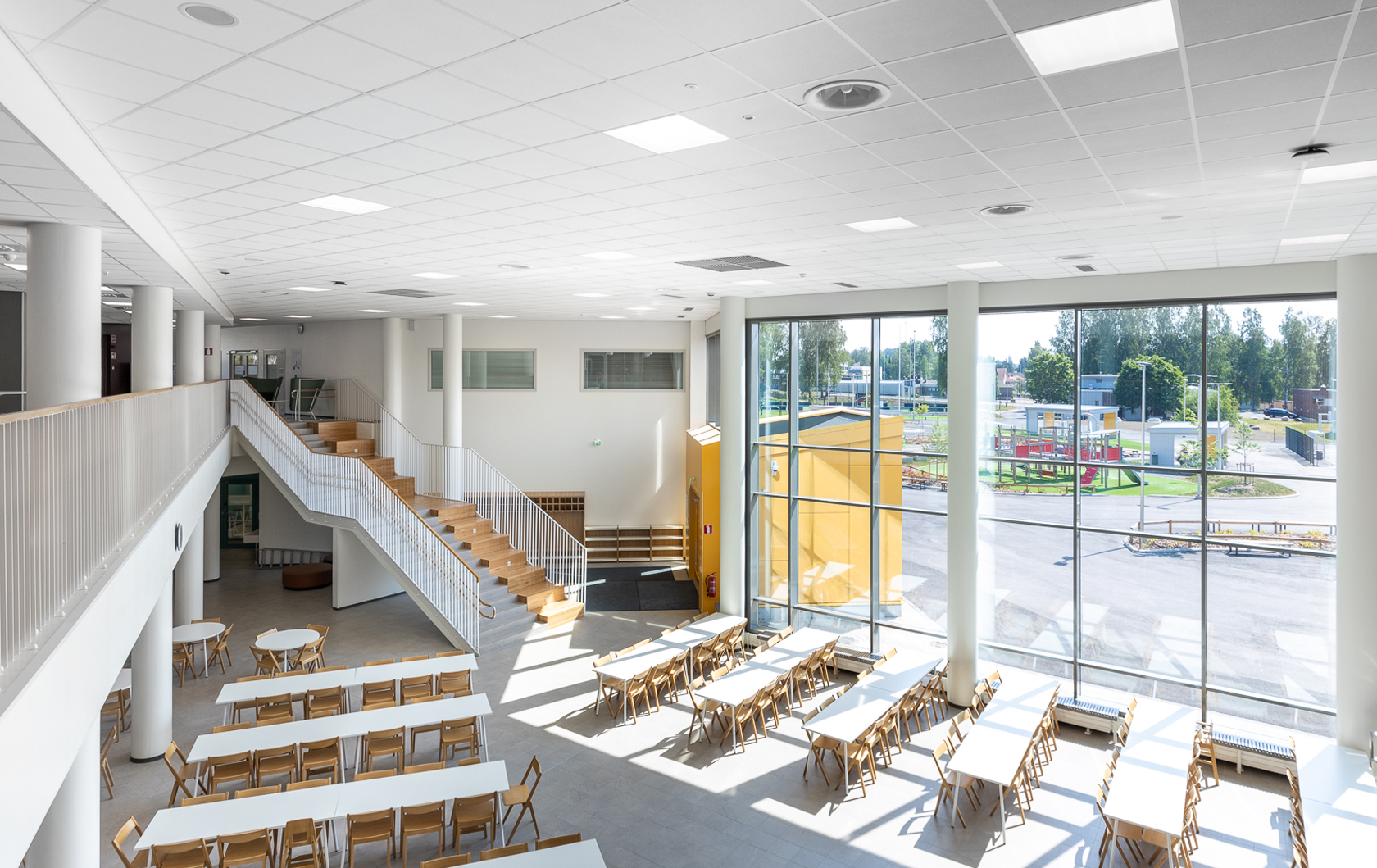
“We are hoping to attract new people to our municipality and communicate to our current residents that we want to keep the municipality vital and focus on young people and families with children living in the countryside”, says Vesa Kankkunen, Director of Technology of the Juva municipality. The school serves as a “town hall” for all residents, and its modern canteen, gymnasium and auditorium facilitate many kinds of events, cinema activities and hobby clubs.
Architectural design guided by users
Juha-Pekka Niinimaa, Design Director of Linja Arkkitehdit, which is now part of Sweco, became involved with the project as early as during the negotiation phase in spring 2018. The plan was developed together with representatives of YIT, the municipality and users. “All basic issues were settled pretty well during the negotiation phase, so we did not need to apply any major changes to the basic solution during the implementation phase.”
Vesa Kankkunen says that he has never before been involved with a project in which users have been able to influence the design solutions to such an extent. The final result is a manifestation of many wishes. “Nobody can claim that the architect was the one to decide what the campus would look like. They listened to us and our wishes were taken into consideration at all stages.”
Based on the municipality’s wish, play and sports equipment suitable for people of various ages were made widely available on the versatile yard. “The yard is so amazing that I feel like going back to school myself”, Kankkunen says. He also considers the interior spaces to be functionally compact. “The functionality of the facilities is on a whole different level when compared to older school buildings.”
Sustainable and safe school construction
As is usually the case with life cycle projects, the schedule for the structural design of the school campus was extremely tight. “We started planning around Christmas and had to start building the school in March”, explains Jouko Rossi, Structural Technology Specialist at Sweco. The structural solutions highlighted operational reliability, safety, cost-effectiveness and a long service life. “In life cycle projects, the constructor has a maintenance responsibility of 20 years.”
When making their choices, the Sweco experts relied on their experience of sustainable school construction accrued over decades. “We implemented the exterior walls with pillar and beam elements, so there was less need for reinforcing partition walls”, Rossi says. Partition walls can be easily dismantled and room sizes adjusted. The ready-made elements settled into place splendidly at the worksite. “So we were able to proceed with frame construction without interruptions.”
The project was implemented by using the Kuivaketju10 operational model (used for reducing and preventing moisture damange in buildings). “We took pre-emptive action in risky spots and made sure that the structural solutions also work in terms of moisture control and building physics”, Rossi says. Moisture control was made easier by the fact that the roof was implemented with ready-made wood elements. “This way, the building could be quickly protected from the weather.”
The school campus is a good fit for the historical town centre
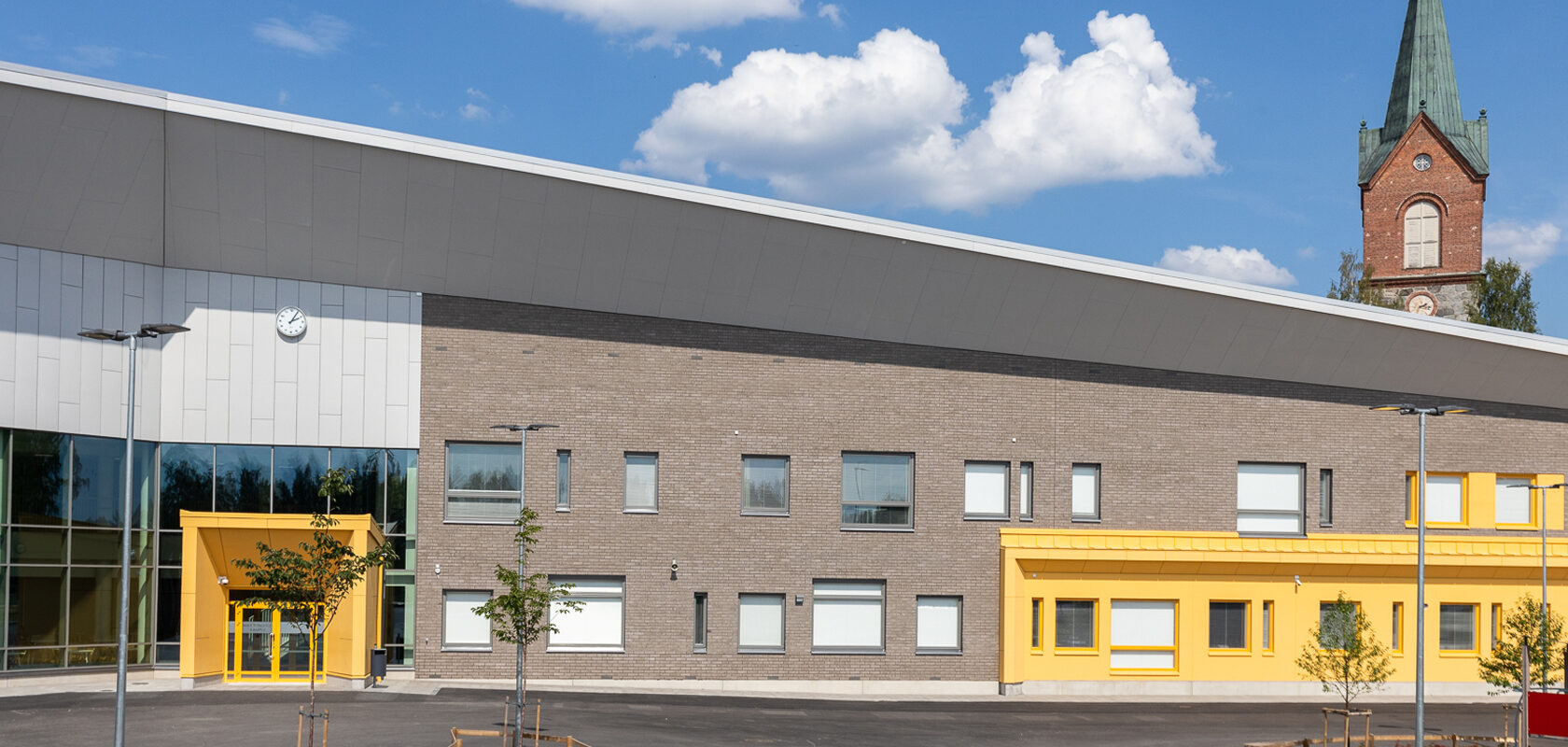
The Martti Talvela school campus is one of the biggest investments of the Juva municipality, and its significance is heightened by the fact that it is located directly opposite the old stone church in the historical town centre. “The campus architecture had to blend into the environment and remain secondary to the church to an appropriate degree. This we managed to do”, Kankkunen explains.
The architects wanted to make sure that the building looks like a school and not a state office building. “A school needs to be designed from children’s perspective and it must be easily approachable”, says Niinimaa. The front yard of the building is designed for use as a public space, and the main entrance is on the second floor on the hillside plot. The client wished that one of the facades would utilise wood, so the main facade is cladded by beautifully greying larch. “This creates a connection with the colour scheme of the old stone church.”
Various functions are smoothly divided into different sections in the building with its three arm-like extensions. “On account of the arm-based model, all spaces are close to the central hall and canteen”, says Esko Pelkonen, Project Architect at Linja Arkkitehdit, which is currently part of Sweco. He, himself, attended elementary school in Juva. The yards used during recess are on the other side of the building on the first floor. “Like in a village school, the recess areas are shared by children of all ages. Only day-care children have their own area.”
In no time, the beautiful school campus has become an important place for municipality residents and an object of admiration and envy for neighbouring municipalities. “We have only received positive feedback on the campus. Previously, the municipality did not have, for example, a gymnasium with suitable dimensions“, says Kankkunen. The adaptability of the facilities, such as the division of the auditorium into four different spaces, has also been praised by users.