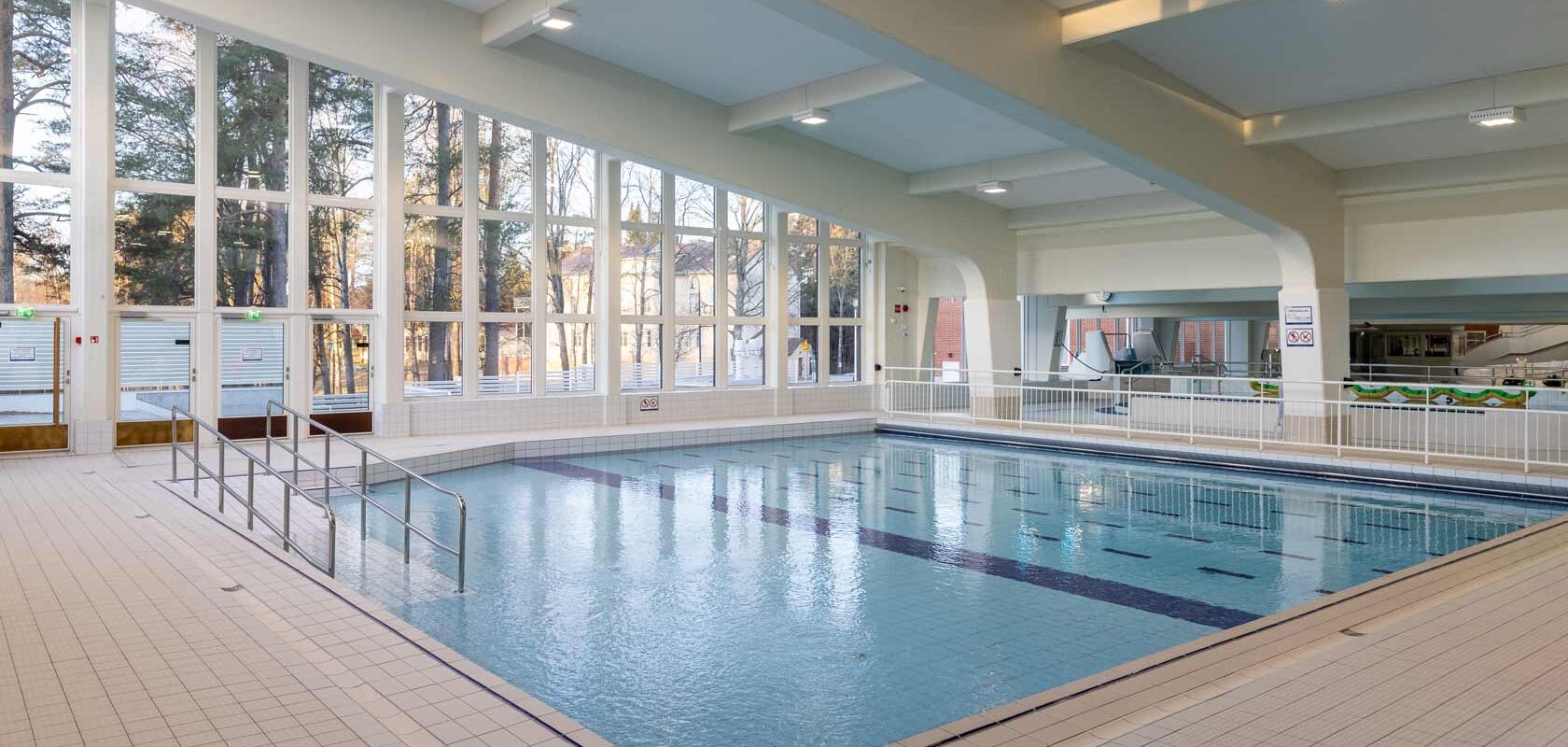
The whole family enjoys the renovated AaltoAlvari water sports centre
The AaltoAlvari water sports centre, which was partly designed by Alvar Aalto, will be renovated in stages. Sweco’s HVAC, automation and water treatment designers applied modern technology to the protected building in a user-oriented manner. The versatile water sports centre will continue to be enjoyed by people of all ages, from small children to competitive swimmers, and from tourists to the elderly.
The protected water sports centre AaltoAlvari was renovated without temporary facilities
The water sports centre AaltoAlvari operates in a building partly designed by Alvar Aalto and expanded several times in Seminaarinmäki, Jyväskylä. Sweco’s HVAC technology, building automation and water treatment designers participated in the renovation and expansion of the protected water sports centre, which was completed in 2024.
“We were able to develop project plans with the principal and architectural designer and rethink the placement of HVAC and water treatment technology from ventilation to water treatment filtration,” says Lauri Paanala, Sweco’s HVAC Technology Team Manager. The functionality of the whole was ensured with a building automation system that controls various technical systems.
It was important to react quickly to questions from the construction site, as the old part of the water sports centre remained open for almost the entire renovation. “There was no need for temporary premises when the contract was planned in two phases,” Paanala says. For example, school swimming and swimming lessons were organised normally.
Project in brief: Water Sports Centre AaltoAlvari
Client: City of Jyväskylä Facility Services
Services included in the assignment: water treatment design, HVAC design and automation design
Year of implementation: 2021–2024
The AaltoAlvari water sports centre is a protected site designed by Alvar Aalto, and both the Alvar Aalto Foundation and museum authorities participated in the renovation.
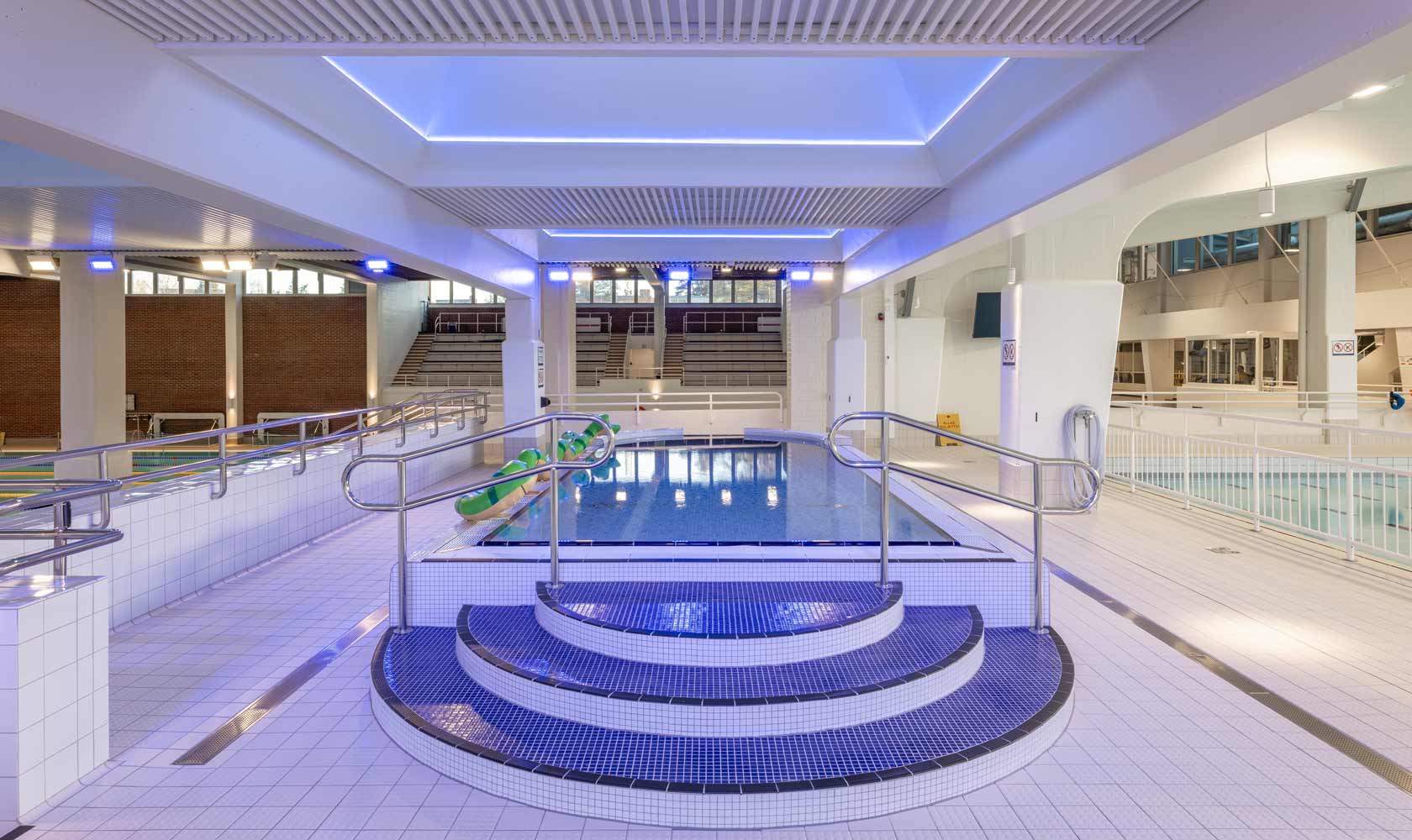
The phasing of the renovation emphasised the experience of swimming hall design
Due to the phasing, the contract area was not uniform, which increased the complexity of HVAC and water treatment design. The design team’s experience in swimming hall construction was also highlighted.
“A contract limit was chosen for the plans in the basement so that the handover of the first phase and the continuation of the next phase could be steplessly successful,” says Antti Laakoli, Chief Specialist in Water Treatment Design at Sweco.
The renovation also included special features, such as a 25-metre transforming basin. According to Laakoli, its height-adjustable lifting base posed its own challenges. “The placement of the nozzles and piping required for water treatment was guided by the mechanical constraints set by the system supplier. In some places, the dimensional tolerances were only seven millimetres.”
The protection of AaltoAlvar affected water treatment and HVAC solutions
Sweco’s designers worked closely with the Alvar Aalto Foundation and the museum authorities. Inside, the strictest protection criteria were in the premises designed by Alvar Aalto, where the teaching pool is located.
“The teaching pool is located at a completely different interest rate level than the other pools,” Laakoli says. The space reserved for water treatment equipment was very limited in the building, which is why it was necessary to compromise on equalisation basins, for example. “We applied different solutions so that we were able to ensure that a sufficient amount of water was transferred, for example, in the renewed wave basin.”
The ventilation ducts leading to the roof had to be curtained, and indoors, protection required air distribution technology between different spaces. “The spa part is directly connected to the 50-metre pool area, which was not part of the project area and whose air and water temperature is a couple of degrees cooler than the spa side,” Paanala says. “That’s why we implemented an air curtain between the spaces, the functionality of which was ensured by flow calculations, i.e. CFD simulations.”
Water treatment design aims to save water
Water treatment design seeks a balance between user safety and water consumption. The pool water must always be clean, but unnecessary water changes must be avoided, as the water consumption is hundreds of thousands of litres per year.
“Rinsing one filter means about 20 cubic metres of water, which means that just five rinsing corresponds to the annual consumption of a small family’s detached house,” Laakoli explains.
Water consumption is increased by the large water slide in AaltoAlvari, which was renovated and repositioned. “The slides increase the need for filtration in water treatment and burden ventilation, as the amount of dirt and evaporation of water increases,” Laakoli says.
For water treatment, a system equipped with UV purification equipment was chosen that is cheaper and less space-consuming than the previous ozonation system. In addition, the water treatment of the pool used for baby swimming is completely separate from the rest of the water circulation system during baby swimming.
“The water is removed from all pools by gravity, and it is directed to the filtration facilities located in the basement below the pools. This meant a physically difficult and long pipeline route at AaltoAlvari as well,” Laakoli adds.
AaltoAlvar’s ventilation units have a drying system
There is rarely a need for cooling in swimming pools, because the temperatures in the pools and air are high all year round, which requires heating. However, AaltoAlvari wanted to prepare for increasing hot spells, which is why the ventilation units were equipped with drying radiators.
“We designed an energy recycling system with heat pumps, which can be used to dry the pool facilities if the outdoor temperatures rise high,” Paanala says. It helps to control humidity conditions, which is important for both the health of the structures and the comfort of bathers. “The air temperature and humidity in the pool facilities are kept the same, whether it is midwinter or hot.”
The end result has received at least the approval of the designer’s own family. “Children like the renovated water sports centre because there are so many different pools,” Paanala says.
The aim of the renovation was to support the well-being of AaltoAlvari’s extensive user base, from visitors to the Hippos sports park to the elderly and families with children.
“Customers have commented that AaltoAlvari has something for everyone: a wide range of different activities, from waves to diving and from water slides to fitness swimming and water aerobics,” says Minni Ukonsaari, Service Manager at the City of Jyväskylä’s Sports Services .