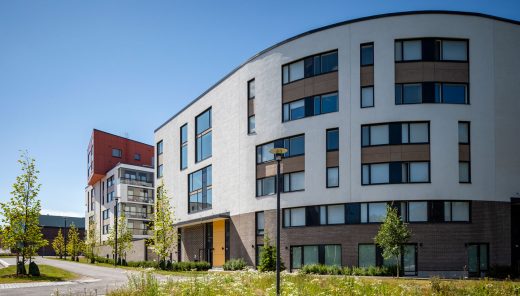
Monikko multipurpose centre brings together young performing arts enthusiasts
The decades-long wait in Nurmijärvi came to an end when Monikko multipurpose centre opened its doors in the Klaukkala sports area. The architecturally eye-catching event venue functions as a setting for both municipal youth facilities and performing arts and culture enthusiasts of all ages.
Monikko is a multipurpose centre in the municipality of Nurmijärvi, designed to support the active cultural life of children and young people. The striking building also serves as an event venue and performing arts arena for the whole municipality. The idea of a multipurpose centre first came up in the municipality 30 years ago, when the youth committee proposed a combined youth centre and swimming pool for Klaukkala in 1990.
“From the very beginning, the plan also included a performing arts hall, which the municipality lacked,” says Merja Winha-Järvinen, the municipality’s since retired youth director, who is considered to be the multipurpose centre’s champion and biggest advocate. The project came to a standstill during the recession of the 1990s, and was subsequently postponed several times, until the idea of a multipurpose centre was given a new lease of life in 2013. The decision was also made to merge the adult education centre, dance institute and music institute into the building. “Indeed, they complement the centre very nicely.”
Activities spread over two floors
Linja Arkkitehdit, which is now part of Sweco, joined the Monikko project in 2013. The first step was to bring together the views of the different operators through extended user meetings, which also gave a voice to those who use the municipality’s facilities on an occasional basis.
“Our task was to identify everyone’s wishes and combine the boundary conditions of different types of activities with high-quality and timeless architecture,” says Niko Ollila, Sweco architect and the principal designer of the site. In dance halls, for example, special attention was paid to acoustics, flexible floor materials and the placement of mirrors.
During the design process, the basement floor of the building had to be abandoned due to the challenging height of the water table, and suddenly the various activities had to be spread over just two floors. At the same time, the architects had to take into account the building’s location as a focal point of the vast Klaukkala sports area. “At the request of the municipality, the facades were accented with wood cladding.”
Monikkosali attracts top performers
Wood surfaces also add some flair to the heart of the building, the Monikkosali hall. “The special features of the performing arts hall include movable stands and acoustics that can be adjusted according to the use of the space,” says Timo Koljonen, business director at Sweco. On the stage and on the sides of the stands, there are movable acoustic elements, one side of which amplifies sounds and the other dampens them.
In addition to hobby groups, the hall has hosted many well-known performers ranging from large orchestras to children’s concerts, from stand-up comedians to theatre stars such as Seela Sella. “The acoustics, stage size and versatility of Monikkosali have received a great deal of praise,” says Siv Jansson, service manager at Monikko. According to her, users have been happy with the facilities, even though the abandonment of the basement floor changed the location of many functions. “The building itself is very beautiful, and many visitors are captivated by the stunning interior when they enter.”
Monikko has a very special place in Winha-Järvinen’s heart. She has deservedly been given her own seat in the auditorium of Monikkosali, and the building’s square has also been named Winhatori, Winha Square. “The best thing about Monikko is that it really became a multipurpose building and has managed to bring together all the culture enthusiasts of Nurmijärvi,” she says. This allows for joint projects between the dance and music institutes, for example. “The young people are also happy with the facilities, even though they are still very new and therefore a bit clinical,” Winha-Järvinen laughs.