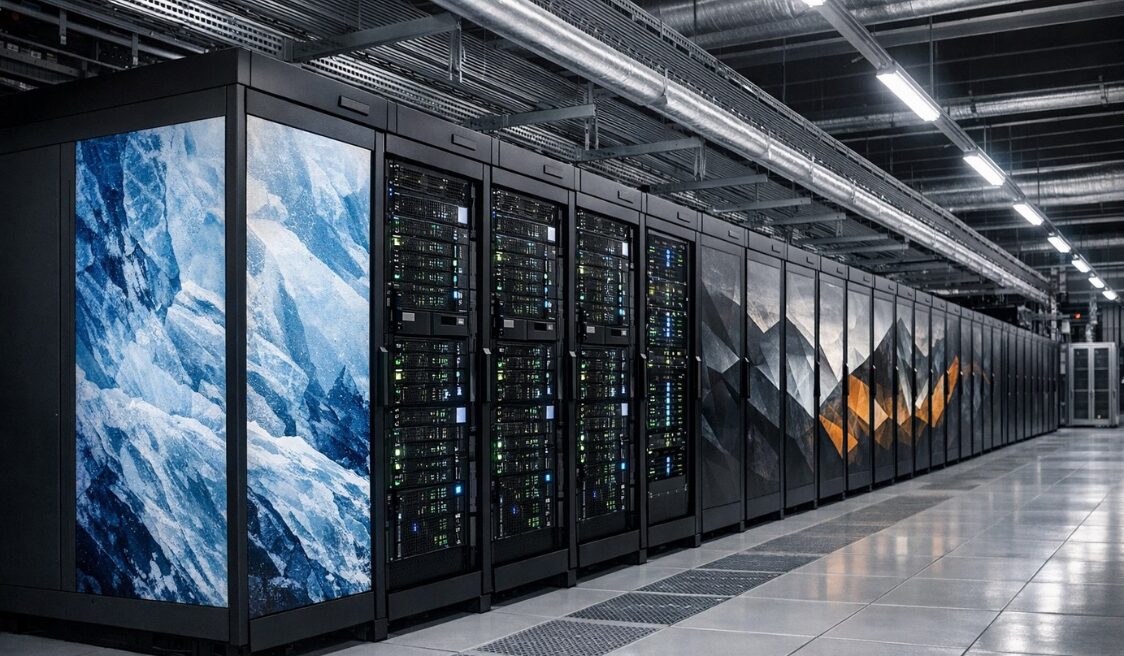
CFD services for data centers
CFD services for data centers
Our CFD (Computational Fluid Dynamics) simulation services provide data center operators an effective way to ensure cooling performance, energy efficiency, and operational reliability already at the design stage. Using computational fluid dynamics, the behavior of air, heat, and contaminants can be modeled both inside the building and in its surroundings. CFD simulations support data-driven decision-making, reduce life-cycle costs, and help meet increasingly stringent environmental and permitting requirements throughout the entire life cycle of the data center.
What?
CFD simulations act as a virtual prototype of the Data Center enabling
to test the design regarding fluid dynamics. Ensuring the complex
design performs as planned mitigates technical risks and enhances
energy-efficiency.
How?
Modern Computational Fluid Dynamics (CFD) analysis is a
supercomputer driven mathematical simulation method for solving how
gases, liquids and particles behave and move. CFD is widely utilized
tool for external and internal data center analyses.
Why?
To create knowledge for the decision making. Utilizing CFD in the
design of Data Centers gives insight and data impossible to gain
otherwise, enabling increase of performance, reduction in life cycle
costs, and longer life span of components. On the other hand, CFD can
be used in permitting phase to show environmental impacts are
properly considered and acceptable.
Flow calculation services for data centers
Internal Analysis
- Analysis of server inlet air temperature
- Airflow optimization measures
- Temperature distribution (hot spot) analysis
- Air humidity analysis
- Fault condition analysis
- Sensor placement prediction
External Analysis
- Heat pump efficiency (cooling optimization)
- Supply and exhaust air efficiency (cooling optimization)
- Waste heat dispersion (environmental impact assessment)
- Emissions / contaminant dispersion (environmental impact assessment)
CFD external analysis
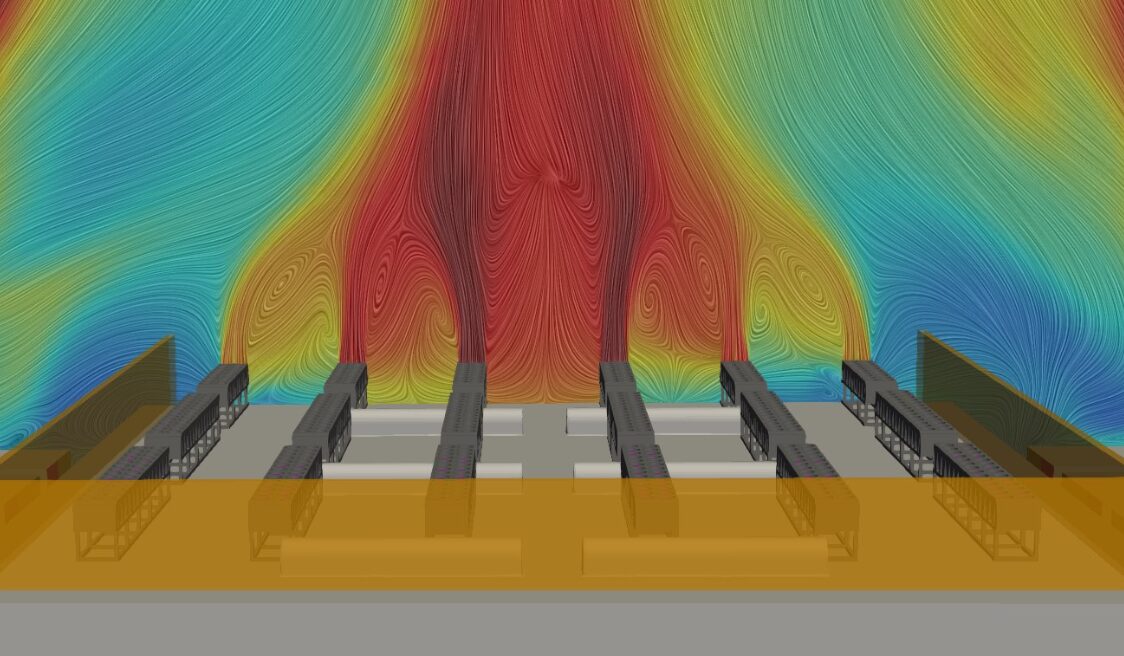
Data center cooling is an important topic from the perspectives of investors, clients, and the environment. Cooling alone can account for approximately 40% of total power consumption. Emerging technologies offer the potential for significant energy savings due to reduced cooling demand, while regulations and sustainability standards are guiding technological development. Due to the complexity of data centers, what works on paper does not necessarily work in practice. For example, placing industrial heat pumps on a rooftop in a certain configuration may lead to undesirable short-circuit airflow phenomena. In addition, data centers are often located near residential areas or sensitive natural environments, which creates a need to assess and mitigate environmental impacts.
Data center cooling efficiency
CFD internal analysis
Using computational fluid dynamics, a virtual prototype of a data center can be created to test different configurations, identify optimization opportunities, and simulate fault conditions, such as cooling unit failures. CFD also helps determine optimal placement of real-time sensors to detect potential hot spots. High temperatures increase the risk of equipment failure and shorten component lifespans. When a cooling unit fails, temperatures begin to rise over time. CFD simulations analyze temperatures and hot spots, humidity levels, and air velocities within the space or near air intakes.
CFD simulations can be used to evaluate different cooling strategies and layout designs, as well as to assess improvements enabled by future expansions or technological developments.
Please dont´t hesitate contact me!
Eero Kokkonen
Department Manager, Chief CFD Engineer