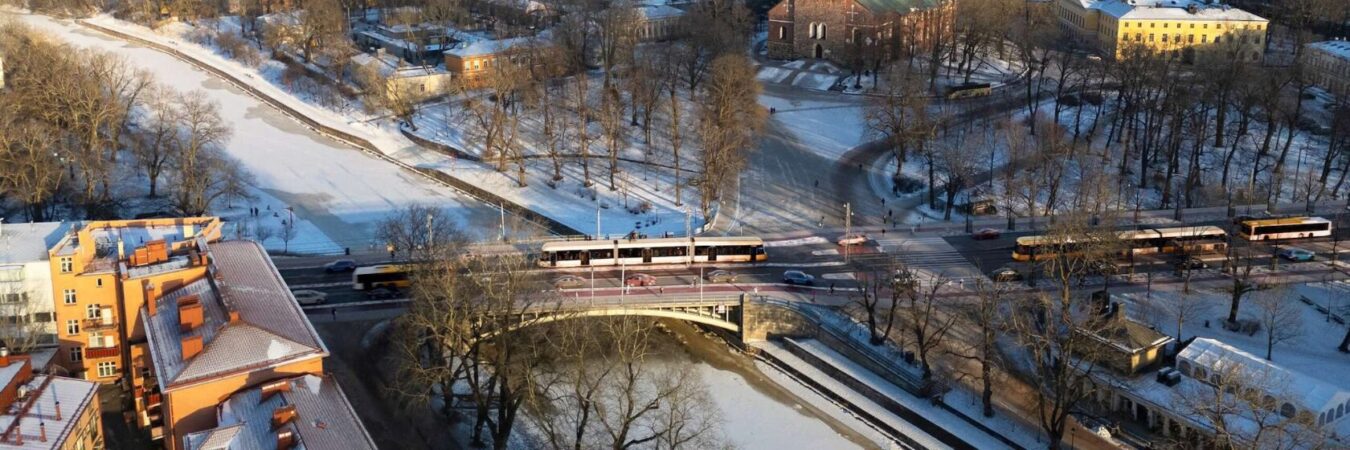
The archaeological investigations conducted for the Turku tramway project are unprecedented in scope in Finland
Illustration: Turku Tramway Alliance
For the first time in Finland, archaeology has been included as one of the alliance’s areas of responsibility in the Turku tramway project. Why are archaeological studies needed specifically in Turku, and how are they managed proactively and on a risk-based basis?
Sweco is involved in the Turku Tramway Alliance together with the client parties Turun Raitiotie Oy and the City of Turku, contractors GRK Suomi and NRC Group Finland, and design partners GRK and Ramboll Finland. Tramway projects are very familiar to us, but our role is now new: we are also responsible for managing archaeological studies and for the duties of the lead conservator.
The Turku Tramway Alliance is doing pioneering work, as archaeology is now included on the alliance’s list of responsibilities for the first time. For example, preliminary studies, the actual archaeological excavations and artefact conservation are procured by the alliance. The alliance is responsible for carrying out the archaeological work and for its costs because of the many benefits this brings. When the alliance is responsible for managing the studies, it can more effectively manage and steer the extensive whole. The alliance’s responsibility also strengthens risk management. At the same time, procurement processes become more agile and flexible.
Investment in archaeology is not made solely because of statutory requirements; the alliance’s objective has always been to preserve and protect as many ancient remains as possible and to adapt the tramway to the special characteristics of the project area.
“For the first time, archaeology is included on the alliance’s list of responsibilities.”
Why does the Turku Tramway Alliance need a director of archaeological research?
At many construction sites, information about the archaeology of the area is needed in the same way as information about nature and environmental values. It is important to know how construction affects the lives of people in the area, waterways, soil and species – as well as archaeological cultural heritage, such as artefact finds and ancient remains.
Managing archaeological studies is a natural role for us, as Sweco is currently the only planning and consulting company in Finland able to offer archaeological expert services for large infrastructure projects and their land-use planning.
As the director of archaeological research, we help guide construction proactively from the perspective of cultural heritage protection.
Archaeology combines fieldwork, legislation and history
Archaeology is characterised by being, at the same time, an activity supervised by authorities, practical fieldwork and the study of the past. This is why it is beneficial to combine different perspectives when managing archaeological excavations within the alliance:
• As an archaeologist, Mikko specialises in issues relating to the protection and assessment of ancient remains, as well as cooperation with authorities. Archaeological excavations and studies are always governed, for example, by the Antiquities Act. Archaeological protection work at the tramway construction site is carried out in accordance with the instructions of the museum responsible for the area, the Turku City Museum.
• Jani is a “hands-on” archaeologist experienced in demanding archaeological projects, and he has been familiar with Turku’s historic city centre for 15 years. Until autumn 2025, Jani carried out archaeological preliminary studies related to the Turku Tramway Alliance at Muuritutkimus Oy. He now continues at Sweco as the responsible director of archaeological research for the project.
• During autumn 2026, Sweco will recruit a lead conservator responsible for artefact conservation for the tramway alliance during archaeological excavations. The conservator will ensure that the flow of artefact finds excavated from the ground is properly transferred from service providers to conservation companies and ultimately to the collection of the Turku City Museum.
The sequence of archaeological excavations can be managed
Archaeological studies in Turku’s historic city centre are essential for the tramway project, but archaeology can also appear to be a challenging component of the project. One of the most important tasks in managing archaeological studies is therefore to support the alliance’s risk management: scheduling, phasing and cost monitoring.
During the implementation planning phase, Muuritutkimus Oy has carried out archaeological zone analyses and test excavations in the area. The preliminary studies have helped clarify the upcoming sequence of events and refine the schedule considerably. We know how excavation, the handling of finds and artefact conservation will affect the project’s costs and schedule.
A functional phasing plan has been created for the construction site, within which archaeological excavations will also be carried out in sections. Excavations will begin in February 2027 next to Tuomiokirkonsilta Bridge. Parts of the project area will be released for construction as work progresses.
“The director of archaeological research supports the alliance’s risk management.”
A time capsule the size of 100 urban plots
The estimated cost of the archaeological excavations for the Turku tramway is EUR 26.6 million. This represents around six per cent of the project’s total budget of approximately EUR 465 million, and is on an entirely different scale from the archaeological tasks in previous tramway projects. Why does archaeology play such a major role specifically in Turku?
Turku is Finland’s oldest city, so its central area has been inhabited for a long time. Individual documents can already be found from the Middle Ages, and excavations in the Cathedral Quarter can provide further information about the lives of people who lived at that time. Archaeological excavation research brings material remains of real people’s lives to light. What we are now protecting and studying at the Turku Tramway Alliance construction site is part of Finnish history.
Turku burned down in 1827, after which it was decided to build on top of the old town plan. The approximately 12-kilometre-long tramway will run for nearly two kilometres through this old town-plan area. Undisturbed cultural layers have remained underground in a time capsule encompassing around 100 former urban plots. Every excavation reveals something new.
“Finnish history is being protected and studied at the tramway construction site.”
Archaeological finds vary across different parts of the city centre
As the moment to begin excavation approaches following the granting of the research permit, the alliance already has a good understanding of the types of archaeological layers that can be found beneath Turku’s historic city centre:
At the eastern end of Hämeenkatu, at the intersection of Aninkaistenkatu and Uudenmaankatu, the cultural layers are thick and well preserved. Artefact finds will be conserved, but the best-preserved archaeological layers will also be retained by using a lighter structure in the area – in other words, a tramway slab that is thinner than usual.
On Aninkaistenkatu, urban construction has already destroyed archaeological layers, and many remains have been cut through by previous municipal engineering trenches. As the route proceeds west and southwest from the city centre, urban settlement becomes more recent and the cultural layers quickly become thinner.
The most significant finds are located on Uudenmaankatu, where there are exceptionally significant remains of old masonry stone buildings on a Finnish scale. Apart from churches, nothing comparable can be found in the built history of medieval Finland.
On Eerikinkatu, archaeological monitoring is provisionally sufficient, as extensive municipal engineering has been excavated in the area in previous decades, destroying cultural layers. An archaeologist will monitor the work while an excavator digs the area in thin layers. If well-preserved cultural layers are encountered, the working methods will shift to manual archaeological excavation.
Would you like to discuss the need for archaeological services in your own infrastructure project? Get in touch!
Jani Vidgren
archaeologist, Sweco
Mikko Helminen
archaeologist, Sweco