Can a historic urban park be renewed without losing its history?
An old urban park is a layered environment that carries traces of the city’s history, the design ideals of different eras, and the personal memories of its residents.
At the same time, the park needs to serve today’s city and adapt to changing needs in the future.
How, then, can a historic park be renewed without losing its most valuable characteristic – its own identity?
A historic park is not a static image of the past
Preserving a historic environment does not mean that nothing can be changed. Cities are constantly evolving, and the ways in which parks are used and the expectations placed on them also change over time.
A park must, for example, be accessible to different users and provide pleasant places to spend time. Climate change also increases the need to consider the vitality of vegetation, stormwater management, shade and heat in the urban environment.
The essential question is therefore not how to avoid change, but how to understand which characteristics make this particular park what it is.
First, we need to understand what we are renewing
Designing a historic park begins with understanding the place and its history. Different periods in the park’s development may be visible in its network of paths, vegetation, views, changes in elevation, structures or the way the park connects with the surrounding city.
It may not be possible or appropriate to preserve everything old exactly as it is. The design process must therefore identify the characteristics that are valuable to the overall setting and determine how they can also be strengthened through renewal. Successful design helps make the park’s history visible.
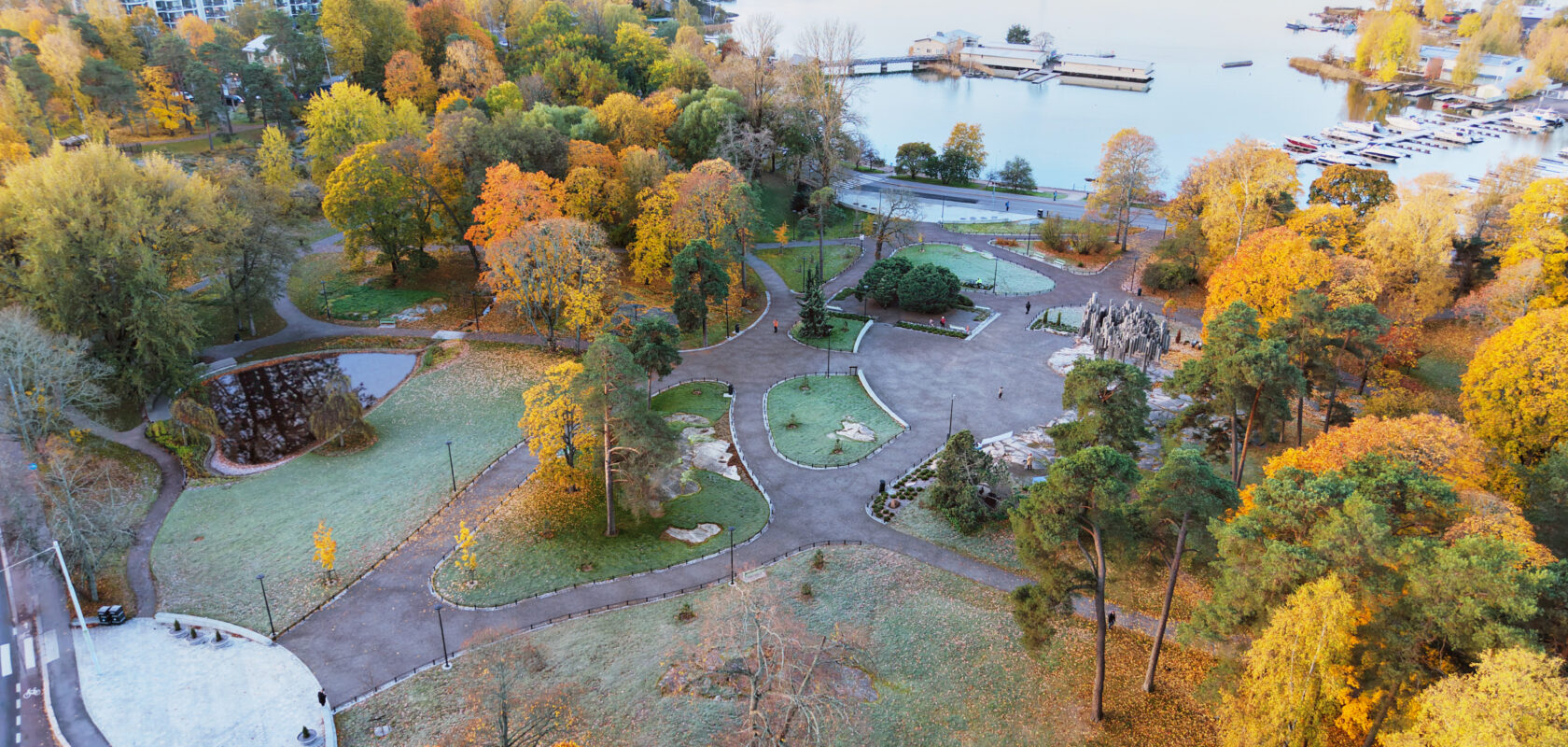
Video below: Sibelius Park, Helsinki
Old and new do not have to compete
In a historic environment, any new solution inevitably enters into dialogue with the old. New structures, furnishings and lighting do not need to imitate the past, but they should fit the scale and character of their surroundings.
Sometimes a subtle solution is the best one. At other times, a well-justified new layer can clearly represent its own era.
What matters is that the solutions form a coherent whole. When renewal is based on a thorough understanding of the existing environment, new functions and solutions can be introduced without losing the park’s recognisable character.
Vegetation makes history particularly challenging
Compared with buildings, parks have one special characteristic: their key building material is alive.
Trees grow and age, plant species change and environmental conditions evolve. Preserving a historic park therefore cannot mean simply preserving the plants that exist today. We need to look decades ahead.
What will the park look like when today’s oldest trees are gone? What should be planted in their place? How can a historically important spatial structure and landscape concept be preserved even when the vegetation inevitably changes?
This is where the long-term perspective of landscape architecture becomes particularly important.
Video below: Johanneksenpuisto Park, Helsinki
Climate change also challenges historic parks
Preparing for the future introduces a new type of design challenge in historic environments. Urban parks need to withstand changing weather conditions while continuing to provide pleasant environments for city residents.
Not all historically used plant species or solutions will necessarily be the most suitable under future conditions. The designer’s task is therefore to find solutions that reconcile the cultural and historical values of the environment with its future functionality and resilience.
The memories of city residents are also part of the place
The significance of a park is not based solely on what has been documented in old plans or inventories. Parks also carry personal and shared histories.
The same bench, lawn or tree-lined path may be an ordinary route through the park for one person and an important part of childhood for another. When a familiar environment changes, even a small alteration can therefore evoke strong emotions.
Engagement and dialogue are an important part of designing historic parks. They not only provide valuable information, but also help explain why renewal is needed and what the changes are intended to preserve for future generations.
Video below: Kaisaniemi Park, Helsinki
Renewal can also strengthen history
After a successful renewal, a park does not necessarily need to look as though nothing has changed. What matters more is that the place still feels like itself.
An old urban park can therefore change without losing its history. In fact, thoughtful renewal can be precisely what enables a historic environment to continue its life.
At its best, a renewed park allows the past, present and future to exist side by side. Old layers are preserved, new ones emerge alongside them, and the park can continue doing what it may already have been doing for more than a century: being part of a changing city.
Author: Tiina Perälä, Leading Landscape Architect