Explosion simulation and blast wave analysis
Explosion simulation and blast wave analysis – Safety and confidence in design.
Explosions and blast waves can pose significant risks to buildings, infrastructure, and industrial facilities. Computational simulation enables the evaluation of these effects already in the design phase—before risks materialize. Sweco’s explosion simulations are based on advanced CFD and structural analysis, allowing us to model explosion scenarios, pressure loads, and structural responses under different conditions.
What can explosion simulation be used for?
Explosion simulation provides valuable insights for decision-making, especially in situations where experimental testing is impossible or prohibitively expensive.
Typical use cases include:
- Assessment of gas and dust explosion impacts
- Safety analysis for hydrogen and energy projects
- Blast wave effects on structures
- Determination of safety distances
- Structural design for accident scenarios
- Risk management in data centers and critical infrastructure
Simulations also enable comparison of different scenarios and optimization of safety solutions.
Dispersion analysis
The dispersion can be a complex phenomena including wind (outdoor) or HVAC (indoor) driven air flows together with complex geometrical structures and temperature gradients. In addition, the gaseous or particulate matter can be lighter or heavier than air or include relatively large particle sizes affecting to the particle dispersion. The complex dispersion analysis can be simulated with CFD.
Blast wave analysis
Blast wave modelling has been a field of research almost over a century to better understand the behavior of their physics. This has led to a development of Equations of State for high temperature and compression gasses and implementation of blast wave parameters into CFD codes. Blast wave simulation is a part of structural design and analysis and it comprises blast wave propagation and reflections form obstacles and walls.
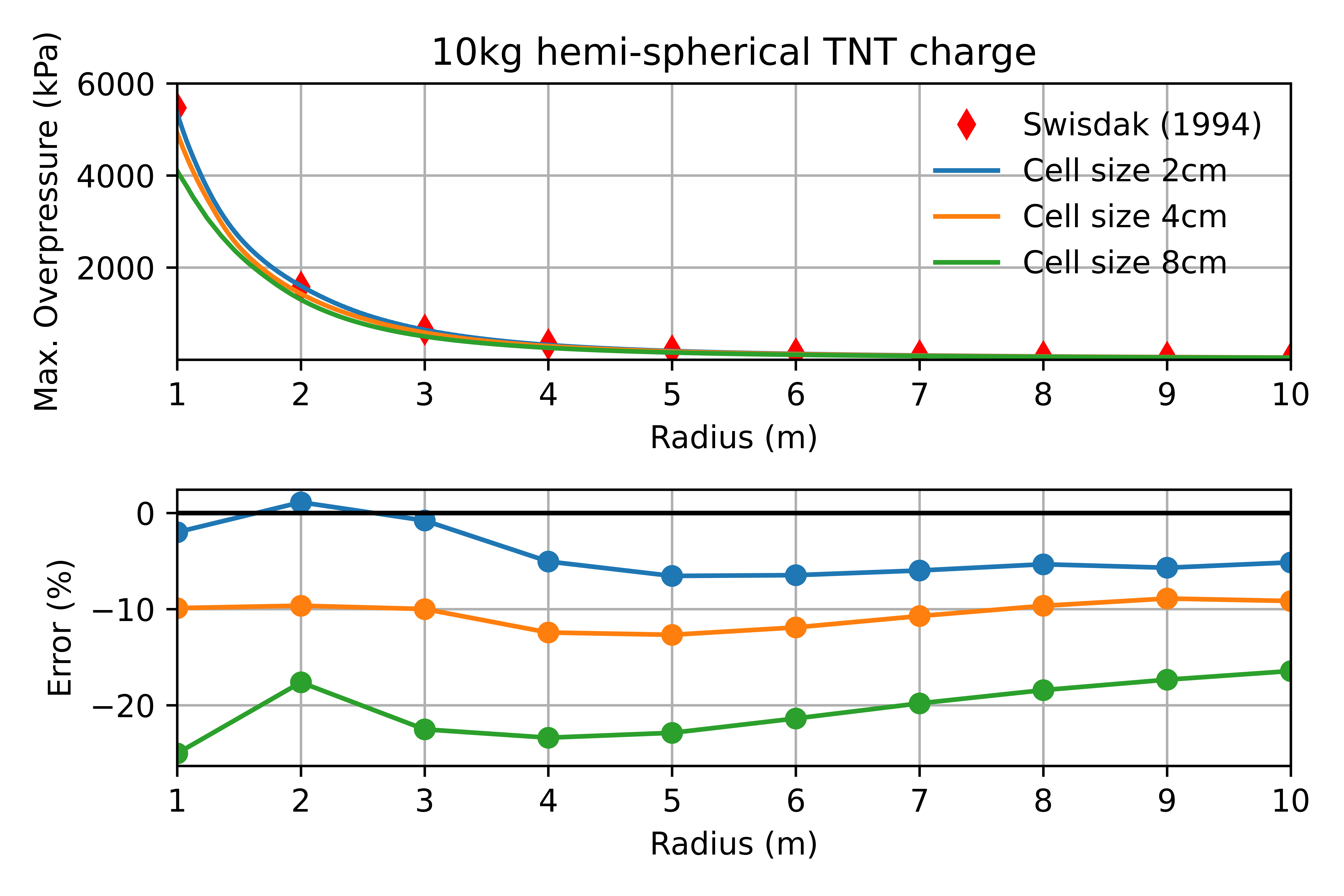
Validation – 10kg hemi-spherical TNT charge
A BlastFoam validation case with a hemispherical surface burst detonation event is considered with a 10kg hemi-spherical TNT charge. The charge is center detonated, using a linear activation model which based on a predetermined detonation velocity. Comparison with Kingery-Bulmash Results (Swisdak, M.M., 1994. Simplified Kingery Airblast Calculations 18.)
Example – TNT Explosion Close to a Building
Pressure wave propagation in indoor and outdoor environment
When a blast wave propagates and collides into a wall it reflects. The reflections may become complex due to obstacles and walls and their behavior cannot be analysed with CFD methods. The overpressure may be controlled by openings which react when a certain overpressure is reached.
Structural analysis of explosions
When the blast wave hits the structure the structure responds dynamically. The deformations, stresses and damages can be analyzed with FEM.
What do we analyze?
We combine Computational Fluid Dynamics (CFD) and structural analysis (FEM) to provide a comprehensive understanding of explosion impacts.
Analysis scope:
Pressure and shock waves (blast waves)
Thermal loads and combustion phenomena
Gas cloud dispersion and ignition
Structural response and damage
Impacts on people (safety)
CFD modelling enables simulation of gas cloud formation and explosion impacts on the surrounding environment already in the design phase.
Methods and tools
We utilize modern simulation methods and computing environments:
Computational Fluid Dynamics (CFD)
Finite Element Method (FEM)
Explicit dynamic simulation (rapid phenomena such as explosions)
Multiphysics models (flows + structures)
The simulations are based on physics-driven models (including the Navier–Stokes equations), solved using high-performance computing clusters.
What are the benefits for the client?
✔ Improves safety and risk management
✔ Enables more cost-efficient design
✔ Supports compliance with regulatory requirements
✔ Reduces the need for physical testing
✔ Provides visual, easy-to-understand data for decision-making
Simulations help identify risks early and reduce the likelihood of accidents.
When is explosion simulation needed?
Design of industrial facilities and processes
Hydrogen production and storage projects
Infrastructure and urban environments
Data centers and energy facilities
Special applications in defense and security
Why choose Sweco as your partner for explosion simulations and blast wave analysis?
Multidisciplinary expertise (CFD + structural engineering)
Experience in demanding safety and infrastructure projects
Ability to integrate simulations into broader design processes
Visual outputs (animations, load maps, scenarios)
Contact us – let’s identify the risks in your project and optimize the design for safety.
Eero Kokkonen
Department Manager, Chief CFD Engineer